
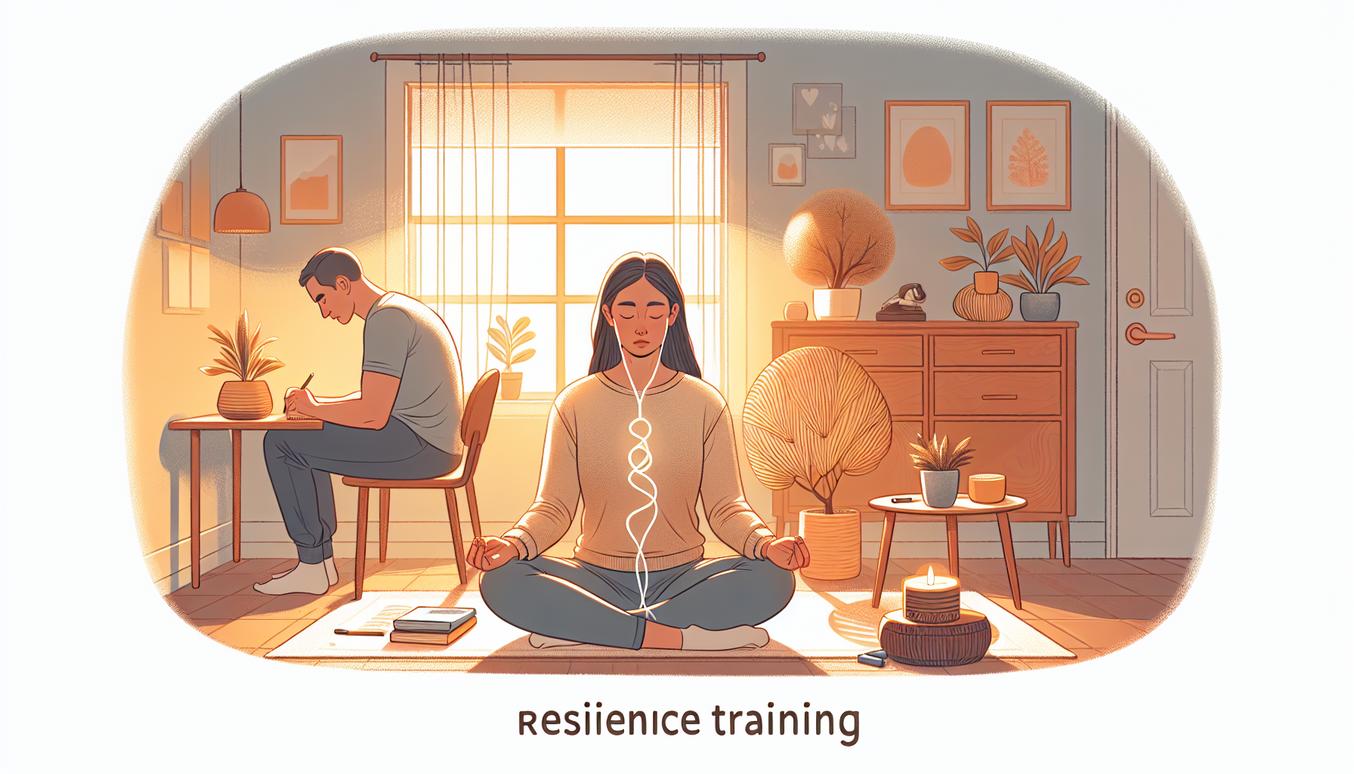
The Ultimate Guide to Resilience Training: Build Mental Strength in 2025
Table of Contents
- What resilience really means and why it matters
- Core skills trained in modern resilience programs
- Short daily practices you can do in 10 minutes
- Building a four week resilience plan
- Group versus individual formats and when to choose each
- How to measure progress and set realistic goals
- Common obstacles and how to adapt practices
- Quick reference exercises and 30 day checklist
- Further reading and resources
What resilience really means and why it matters
Life is full of challenges, from daily frustrations to significant life events. The ability to navigate these difficulties without losing your center is the essence of resilience. It’s often misunderstood as a trait you either have or you don’t, but modern psychology sees it differently. Resilience is not about avoiding stress; it’s about recovering from it effectively. Think of a willow tree that bends in a storm but doesn’t break—that’s resilience in action.
Why does it matter so much? Because building resilience is fundamental to our mental health and overall well-being. It’s the foundation that allows us to manage stress, overcome adversity, and maintain a sense of purpose and optimism. In the professional world, resilient individuals are better equipped to handle pressure, adapt to change, and lead effectively. Engaging in Resilience Training is a proactive investment in your capacity to thrive, no matter what comes your way. It is a learnable skill set that empowers you to bounce back stronger from life’s inevitable setbacks.
Core skills trained in modern resilience programs
Effective Resilience Training programs focus on developing a set of core, evidence-based skills. These aren’t complex theories but practical tools that help you manage your thoughts, emotions, and behaviors in real-time. The goal is to build a mental toolkit you can draw from whenever you face a stressful situation. The two primary pillars of this training are learning to manage your thoughts and regulate your emotions.
Cognitive reframing techniques
Cognitive reframing is the practice of identifying and changing the way you view situations, thoughts, and feelings. Our perspective has a powerful impact on our emotional state. By shifting from a negative or unhelpful viewpoint to a more balanced or constructive one, you can fundamentally alter your experience of stress.
- Challenging Automatic Negative Thoughts (ANTs): We all have them—the knee-jerk negative thoughts that pop up in stressful moments. A key resilience skill is to catch these thoughts and question their validity. Ask yourself: “Is this thought 100% true? What’s a more balanced way to see this?”
- The ABC Model: This technique breaks down your reaction to stress into three parts: A (Activating Event), B (Belief about the event), and C (Consequence or your emotional response). Resilience training teaches you that by changing your Belief (B), you can change the Consequence (C), even if you can’t change the Event (A).
- Worst, Best, Most Likely Case: When you’re catastrophizing, take a moment to consider the absolute worst outcome, the best possible outcome, and the most realistic, likely outcome. This often brings your perspective back to a more manageable middle ground.
Emotional regulation exercises
Emotional regulation is not about suppressing your feelings. It’s about understanding, managing, and responding to them in a healthy way. When you’re emotionally dysregulated, your rational brain takes a backseat, making it difficult to think clearly. These exercises help you stay in control.
- Mindful Breathing: The simple act of focusing on your breath can activate your body’s relaxation response. A common technique is “box breathing”: inhale for 4 seconds, hold for 4, exhale for 4, and hold for 4. Repeat this for a minute to calm your nervous system.
- Grounding Techniques: When you feel overwhelmed, grounding brings your awareness back to the present moment. The 5-4-3-2-1 method is highly effective: name 5 things you can see, 4 things you can feel, 3 things you can hear, 2 things you can smell, and 1 thing you can taste.
- Emotional Labeling: Simply putting a name to your emotion (e.g., “This is anxiety,” or “I am feeling frustrated”) can reduce its intensity. It creates a small space between you and the feeling, giving you more power over your reaction.
Short daily practices you can do in 10 minutes
Consistency is more important than intensity when building mental resilience. You don’t need to block out an hour every day. Integrating short, simple practices into your existing routine is a powerful way to make progress. The goal of this micro-approach to Resilience Training is to make it sustainable.
- Morning Mindful Minute: Before you check your phone, spend just one minute focusing on your breath. Notice the sensation of the air entering and leaving your body. This sets a calm tone for the day.
- The “What Went Well” Review: At the end of your workday, take three minutes to write down three things that went well, no matter how small. This practice trains your brain to scan for positives, counteracting our natural negativity bias.
- Gratitude Check-in: While brushing your teeth or making coffee, think of one person or thing you are genuinely grateful for. Feeling gratitude is a powerful antidote to stress and rumination.
- Purposeful Pause: Set a random alarm for midday. When it goes off, stop what you’re doing, take three slow, deep breaths, and check in with your body. Are your shoulders tense? Is your jaw clenched? Consciously release that tension.
Building a four week resilience plan
Starting a new practice can feel daunting, so here is a simple, structured plan for your first month. This framework introduces one core skill each week, allowing you to build a solid foundation without feeling overwhelmed. Remember, this is a guide, not a rigid set of rules. Adjust it to fit your life.
Week by week practice outline
- Week 1: Focus on Awareness. The goal this week is simply to notice your internal state without judgment. Your daily practice is a 3-minute mindful breathing exercise. Each day, simply sit and pay attention to your breath. When your mind wanders (which it will), gently guide it back. The goal isn’t to have an empty mind, but to practice returning your focus.
- Week 2: Introduce Emotional Regulation. Continue your daily breathing practice. This week, add a regulation technique. When you notice a strong, difficult emotion (like frustration or anxiety), use the 5-4-3-2-1 grounding technique. Do this just once a day when you feel stressed. This builds the habit of pausing instead of reacting.
- Week 3: Practice Cognitive Reframing. Keep up your breathing practice. This week, add a simple reframing exercise. Once a day, identify one automatic negative thought you had. Write it down and then write down a more balanced, realistic alternative. Scenario: Your boss gives you constructive feedback. Your automatic thought (B) might be, “I’m terrible at my job.” The emotional consequence (C) is shame. Your reframing practice is to change B to: “This feedback is a chance to improve my skills.” The new C is a feeling of motivation.
- Week 4: Integrate Your Skills. This week, bring it all together. Continue your daily practices. Your goal is to consciously use your new skills in a challenging situation. When a stressor occurs, try this sequence: 1. Notice your emotional and physical reaction (Awareness). 2. Pause and take three deep breaths (Regulation). 3. Identify and challenge any unhelpful thoughts about the situation (Reframing).
Group versus individual formats and when to choose each
Resilience Training can be undertaken in different formats, and the best choice depends on your personality, goals, and circumstances.
Individual Training: This format, often done with a coach or therapist, offers a deeply personalized experience. It’s ideal if you are working through specific personal challenges, have a very particular goal in mind, or simply prefer a private setting. The one-on-one attention allows for a tailored approach that moves at your pace.
Group Training: Participating in a group workshop or program provides a sense of community and shared experience. Hearing from others who are facing similar struggles can be validating and reduce feelings of isolation. Group settings are excellent for learning general resilience skills, building team cohesion in a professional context, and gaining diverse perspectives. They are also often a more accessible starting point.
How to measure progress and set realistic goals
Building resilience is a process, not a destination. Measuring progress helps you stay motivated and recognize your growth. Instead of looking for a dramatic change, focus on small, consistent shifts in your daily experience.
- Keep a Simple Journal: At the end of each day, briefly note how you handled a stressful moment. Did you remember to pause? Did you reframe a thought? Tracking your use of the skills is a tangible measure of progress.
- Notice Your Recovery Time: A key sign of increased resilience is a shorter “bounce-back” time. You may still get upset or frustrated, but you’ll find you don’t stay in that negative state for as long.
- Set SMART Goals: Make your goals Specific, Measurable, Achievable, Relevant, and Time-bound. Instead of a vague goal like “be more resilient,” set a goal like, “For the next two weeks, I will practice box breathing for two minutes every workday before my first meeting.”
Common obstacles and how to adapt practices
It’s normal to encounter challenges when building new habits. Anticipating them can help you stay on track. Here are some common obstacles and how to navigate them:
- “I don’t have time.” Reframe this. You don’t need an hour. Can you find two minutes? Link a new practice to an existing habit. For example, practice mindful breathing while your coffee brews. A little is always better than none.
- “I keep forgetting.” Use technology to your advantage. Set a daily reminder on your phone or calendar. A simple sticky note on your computer monitor can also serve as a powerful visual cue.
- “I don’t feel like it’s working.” Resilience is built incrementally, like muscle. You don’t see a difference after one trip to the gym. Trust the process and celebrate small wins. Acknowledge yourself for simply showing up and trying.
- “I’m not doing it perfectly.” There is no “perfect” way to be resilient. The goal is progress, not perfection. If you miss a day, just start again the next. Self-compassion is a critical component of resilience itself.
Quick reference exercises and 30 day checklist
Here is a quick summary of the exercises and a simple checklist you can use to track your first 30 days of Resilience Training in 2025.
- Mindful Breathing: Inhale slowly, hold, and exhale slowly. Focus only on the breath.
- 5-4-3-2-1 Grounding: Name 5 things you see, 4 you feel, 3 you hear, 2 you smell, 1 you taste.
- Cognitive Reframe: Catch a negative thought, question it, and replace it with a more balanced one.
- What Went Well: List three positive things from your day, no matter how small.
| Day | Practice Focus (10 min max) | Completed [ ] |
|---|---|---|
| 1-7 | Week 1: 3-Minute Mindful Breathing | [ ] |
| 8-14 | Week 2: Add 5-4-3-2-1 Grounding (once daily) | [ ] |
| 15-21 | Week 3: Add 1 Cognitive Reframe (once daily) | [ ] |
| 22-30 | Week 4: Integrate all skills as needed | [ ] |
Further reading and resources
Building resilience is a journey of continuous learning and practice. The skills you develop through consistent Resilience Training will serve you in every area of your life, helping you navigate the future with greater confidence and calm. As you continue to grow, exploring additional resources can provide deeper insights and support.
For more information from leading organizations, consider these resources:
- The American Psychological Association offers comprehensive information on the science of resilience. Further reading on resilience.
- The World Health Organization provides evidence-based guides on mental health and stress management. Stress management evidence.
- The National Institute of Mental Health details various therapeutic approaches that help build resilience. Overview of psychotherapies.